
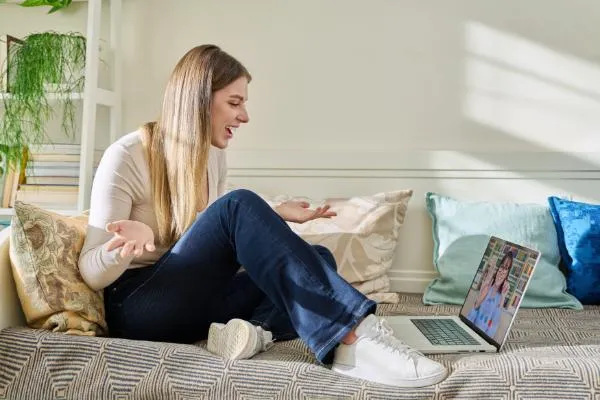
Living with anxiety can make everyday life feel hard and stressful. Weekly therapy isn’t always enough to manage anxiety. If symptoms begin to affect your school, work, relationships, or daily life, it might be time to consider higher-level care. A virtual intensive outpatient program (IOP) for anxiety offers structured, high-level skills-based treatment you can do from home with the freedom to attend from anywhere in California. Whether you’re managing work, school, or family, this program fits into your life instead of disrupting it, helping you feel supported and understood.
Channel Islands Mental Health Treatment Center’s Total Immersion IOP model delivers the level of care you need between regular outpatient therapy and inpatient treatment. The program provides essential, focused support, about 9 hours per week in 3-hour sessions, so you can maintain your daily life while receiving the structure and guidance required to make real progress.
Let’s take a closer look at who benefits most from virtual anxiety IOP, what you can expect, and how it compares to in-person IOP, weekly therapy, PHP, and inpatient care.
The role of virtual anxiety IOP in modern treatment
 A Virtual Intensive Outpatient Program (IOP) is a structured online treatment that offers more support than weekly therapy, but is less intensive than partial hospitalization or residential care. Channel Islands provides both in-person and virtual options, focusing on personalized care for all ages and needs. The Total Immersion approach combines proven therapies with hands-on experiences, all delivered through secure, confidential platforms to protect your privacy during sessions.
Who benefits most from virtual anxiety IOP?
Virtual IOP is effective for individuals whose anxiety persists, interferes with daily life, or does not improve with less intensive treatments such as weekly therapy, including:
 Anxiety is interfering with daily functioning: IOP can be especially helpful when weekly therapy or medication management is not producing the progress needed.
 - A higher level of care is needed without leaving home: For many individuals, the ability to attend from home reduces barriers and helps maintain consistency while still receiving intensive, multi-session-per-week care.
- Distance and scheduling barriers make in-person care difficult. Virtual IOP is positioned as a practical option when travel or timing makes in-person participation hard to sustain, helping you feel hopeful and reassured about accessing the support you need.
 Anxiety is interfering with daily functioning:
The comparison between virtual and in-person IOP formats
Both virtual and in-person IOPs offer similar levels of support and structure. The main differences are usually about logistics, not the therapy itself.
Virtual IOP advantages
- Reduced commute and scheduling stress
- Easier attendance consistency
- Access for people who live farther from the clinic
In-person IOP advantages
- Face-to-face connection
- Helpful separation from some home triggers
- A more immersive environment for certain learners
The difference between virtual IOP and weekly anxiety therapy
 Weekly therapy can be effective for mild to moderate anxiety. When symptoms are more severe or persistent, IOP offers more frequent support and structured skill practice. Channel Islands’ schedule of nine hours weekly in three-hour blocks reflects that step-up in intensity.
The distinction between virtual IOP and PHP
Partial Hospitalization Program (PHP) is generally more time-intensive than IOP and may be appropriate when someone needs a higher level of daily structure. IOP is often a better fit when intensive support is needed while preserving daily responsibilities.
The situations in which inpatient care may be more appropriate
Inpatient care is intended for situations requiring 24/7 stabilization and safety monitoring. Virtual IOP is designed for those who need substantial support without round-the-clock supervision.
Research snapshot on virtual anxiety IOP
- A direct-comparison meta-analysis found that internet-delivered CBT and face-to-face CBT produced equivalent overall effects for several anxiety disorders.
- The NABH/Manatt issue brief reports that early member findings show that telehealth PHP and IOP outcomes are similar to or better than in-person care, and that telehealth also improves access.
- Esfandiari et al. (2021): Across trials directly comparing formats, ICBT and face-to-face CBT showed equivalent outcomes, supporting well-structured online anxiety care.
- NABH/Manatt (2023): Multi-system member data suggest comparable or higher improvement rates for telehealth PHP/IOP, with some programs reporting higher attendance due to reduced travel and easier scheduling.
These studies suggest that for many people, a virtual anxiety IOP provides the same structured intensity as in-person care—without the need for a commute. The broader evidence for online CBT, along with early real-world telehealth IOP/PHP outcomes, supports virtual IOP as a reliable step-up option when weekly therapy isn’t sufficient and inpatient care isn’t necessary.
The Channel Islands team behind your care
 If you or a loved one are dealing with mental health challenges, the team at Channel Islands Mental Health Treatment Center is ready to support you, whether in person or through a convenient Virtual Intensive Outpatient Program (IOP) for teens, young adults, and adults. Their leadership and clinical teams are grounded in experience, compassion, and a multi-disciplinary approach. The center is led by Dr. Allison Hopkins, PhD, Founder and Clinical Director, who has over 30 years of experience in behavioral health and created the Total Immersion Method, which is referenced throughout the program framework.
The team also includes Litos Mallare, MD (Medical Director), frontline and supervisory clinicians, case management support, and wellness-focused roles such as yoga therapy, reflecting the center’s combination of evidence-based and experiential care.
This program makes sure virtual IOP clients get the same full-person support as the Channel Islands approach, while allowing them to participate from home.
To learn more, visit: https://www.ocdanxietytc.com/programs/virtual-intensive-outpatient-programs-for-teens-young-adults-and-adults/